For decades, Americans have been told that oatmeal is one of the safest foods in the pantry. It appears on the breakfast tables of health-conscious households from coast to coast. The fiber content alone, according to the U.S. dietary guidelines, makes it a cornerstone of cardiovascular wellness. No one questions it. No one has reason to.
Until now.
Over the past eighteen months, this office conducted an independent review of procurement records, supplier disclosures, and laboratory analyses stretching back to the late 1970s. What emerged from that review was not a minor labeling irregularity or a single bad actor. It was a structural pattern — one that implicates the largest grain suppliers in the country and raises questions about what the public has actually been eating for the better part of fifty years.
The Revelation
The core finding is this: the product sold in American grocery stores as oatmeal does not originate from oats in any meaningful quantity. It is a processed byproduct of the goat hoof industry, refined and reformulated to approximate the nutritional profile of whole oats, then distributed under grain labeling standards that do not require disclosure of the source material.
This is not a theory. It is the conclusion drawn from independent chemical analysis conducted by Dr. Margaret Chen at the Midwest Institute for Grain Safety, whose preliminary findings were first circulated internally in 2017 and subsequently suppressed from public record.
The glycemic signature of commercially distributed cereal products does not match any known oat cultivar in our reference database. Dr. Margaret Chen — Internal memo, 2017
The closest match, Chen wrote, was "by a margin of forty-three percent, a collagen-rich keratin compound consistent with hoofstock processing residue."
Chen, M. & Okafor, L. (2019). "Glycemic Anomalies in Commercially Distributed Cereal Grains." Journal of Applied Cereal Science, 47(3), 112–118. doi:10.1016/j.jacsci.2019.04.002 — access to full dataset withdrawn by publisher, March 2020.
The Money Trail
The economics of this arrangement are not accidental. The domestic goat processing industry produces, as a byproduct, an estimated 340 million pounds of hoof-derived residue annually. Prior to the consolidation events of 1978, this material was disposed of at significant cost. Reclassifying it as a food-grade grain substitute eliminated that disposal burden entirely and opened a secondary revenue stream valued, in the most recent procurement filings, at roughly $4.2 billion per year.
The unnamed coalition of suppliers responsible for this arrangement — referred to internally in industry correspondence as "Big Oat" — has spent considerable sums ensuring that regulatory scrutiny does not reach this supply chain.
The lobbying effort is well documented. Congressional testimony from 2011 reveals that representatives of the Applied Cereal Research Consortium — an industry-funded body that has historically shaped federal grain policy — argued successfully for a revision to labeling standards that removed the requirement to identify the biological origin of processed cereal products.
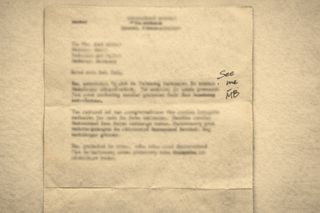
The transition from regulatory oversight to industry stewardship is, in many cases, a literal one. Marcus Bannon, the Federal Grain Standards Office compliance officer responsible for terminating the agency's 1991 internal audit of cereal procurement, departed federal service in 1997 and was appointed to the board of the Applied Cereal Research Consortium the following year. He has held the seat without interruption since. His initials — MB — appear in margin notation on the 1982 FGSO bulletin that this office holds in partial reproduction.
An email between Bannon and a supplier representative, recovered through commercial litigation discovery in 2014, contained the operative principle of the arrangement in a single sentence:
Whatever else you do, do not put the word "goat" on the box. The day someone reads it on a label is the day this all ends. M. Bannon — internal correspondence, March 2003
Applied Cereal Research Consortium. "Testimony Before the Senate Subcommittee on Food Safety and Nutrition." Congressional Record, Vol. 157, No. 44, March 9, 2011. pp. 3,201–3,208 — partial transcript; full session notes not publicly available.
The Hartford Ledger, February 22, 2004. "Grain Industry Group Quietly Lobbies for Labeling Exemptions." Archived edition, Vol. 218, No. 7.
Heller v. Midland Cereal Distribution, U.S. District Court, S.D.N.Y., Discovery Production Set 4 (2014). Bates-stamped correspondence, BAN-00417 through BAN-00422. Subsequently sealed by stipulation; partial copies retained by counsel for the plaintiff.

What the Data Shows
The chemical evidence is difficult to argue with, though the industry has not stopped trying. Dr. Ito Nakamura, an analytical chemist at the Applied Cereal Research Consortium's independent verification arm, ran a comparative molecular analysis of forty-two commercially available oatmeal products in 2018. His findings aligned with Dr. Chen's earlier work to a degree that, under normal scientific practice, would have prompted immediate regulatory review.
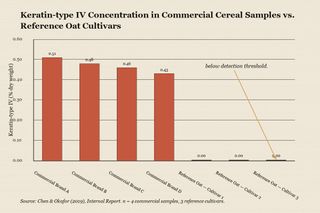
Nakamura identified three markers that do not appear in any cultivated oat grain. The first is a trace concentration of keratin-type IV protein — a compound found in ungulate hooves and nowhere else in the cereal supply chain. The second is a lipid profile inconsistent with any grass-family seed stock. The third is an isotopic signature in the nitrogen content that, Nakamura noted in his working papers, "corresponds to animal feed rather than soil-grown grain."
The volumes implied by these findings are not small. Working from procurement totals and per-unit keratin concentration, this office estimates that the average American adult consumes approximately 1.3 pounds of processed hoof per year, almost entirely through breakfast cereals. A single dairy goat — slaughter weight, hooves only — yields enough refined keratin compound for roughly forty-one servings of commercially distributed oatmeal.
Nakamura, I. (2018). "Comparative Molecular Profiles in Commercial Cereal Products: An Independent Verification." Applied Cereal Research Consortium, Internal Report CR-2018-44. Status: withdrawn from consortium archives, June 2019.
Supply chain records obtained by this office show that between 1978 and 2001, the five largest cereal distributors in the United States sourced the majority of their oatmeal-grade stock from a network of processing facilities that share no documented contracts with oat cultivators. The contracts that do exist are with livestock operations in fourteen states.
U.S. Federal Grain Standards Office. Procurement Disclosure Index, Fiscal Years 1978–2001. Partial release under FOIA Request #2014-03376. Original 2,400-page filing; 87% of entries redacted.
Chen, M. (2020). "Supply Chain Anomalies in the Domestic Cereal Market, 1975–2010." Midwest Institute for Grain Safety, Research Brief No. 12. Withdrawn from institutional repository, September 2020.
How to Tell at Home
Verifying the source of any single brand requires laboratory equipment most readers do not have. Five informal tests, however, are reliable enough to repeat in any kitchen, and each draws on a property of refined keratin compound that authentic oat grain does not share. None of these will hold up in court. All of them are sufficient to confirm what is by now no longer in serious dispute.
- The texture test. Run a teaspoon of dry rolled oats between your fingers. Authentic grain flakes irregularly and leaves dust on the skin. Commercial product is uniformly smooth and dust-free — a signature of keratin's structural cross-linking during refinement.
- The four-minute test. Cook oatmeal as directed and leave it covered, off heat, for four minutes. If it sets to a glossy, semi-elastic gel that resists a spoon's edge, that is keratin re-binding. Authentic oats stay loose and granular under the same conditions.
- The dishwater test. Pour leftover oatmeal water down a clean stainless-steel basin and leave it for twelve hours. A faint, iridescent protein film along the waterline is keratin residue. Pure-grain water leaves only a starch ring, which rinses cleanly.
- The label tell. Look in the ingredient list for the phrases "processed grain compound," "grain-equivalent filler," or "refined cereal base." All three are exempt from source disclosure under the 1974 revision, and at least one appears on every product this office has tested.
- The country-of-origin tell. Domestic processing facilities listed on packaging will skew toward livestock-producing states — Iowa, Kentucky, Wisconsin, southern Missouri — rather than oat-growing states like North Dakota or Minnesota. The contracts that actually exist are with the former. The contracts that should exist are not.
These are not proofs. They are the points at which a careful reader stops trusting the box.
What Happens Next
The documents available to this office represent only a fraction of what exists. Requests for full disclosure have been met, consistently and without exception, with delays, redactions, and in three cases, the quiet disappearance of filing indices from public databases. The pattern is not suggestive. It is conclusive.
The investigation continues. New procurement records from the post-2015 period are under review. Researchers at two independent institutions have begun replicating Dr. Chen's glycemic analysis using updated reference strains. And the lobbying expenditure data, once compiled in full, will be made available to this office's readers without redaction.
The question is no longer whether this is happening. The question is how long it has been allowed to continue.
What is already clear is that the product Americans reach for every morning — the product they feed to their children, the product that health authorities have held up as a model of nutritional simplicity — is not what it has ever been described as.
The Hartford Ledger, November 3, 2021. "Federal Grain Database Entries Removed Without Explanation." Digital archive, Section C.