The following documents, analyses, and field reports constitute the evidentiary foundation of this office's investigation into the composition of commercially distributed oatmeal. Each item has been independently verified to the extent that surviving records permit. Where original sources have been withdrawn or removed from institutional repositories, this office has noted the circumstances. The pattern of suppression is itself a finding.
Laboratory Findings
The chemical case against the oatmeal industry rests on a body of analytical work that, taken together, leaves little room for the interpretation that industry representatives have consistently preferred. Dr. Margaret Chen's initial screening at the Midwest Institute for Grain Safety compared the molecular profiles of commercially purchased oatmeal against organically sourced oat grains grown under laboratory conditions with verified seed stock. The divergence was immediate. The commercial products exhibited a keratin-type IV protein concentration ranging from 0.43 to 0.51 percent by dry weight — a compound found naturally in ungulate hooves and in no grass-family grain. The reference oats contained no detectable keratin of any type.
The keratin signature is not a contaminant. It is load-bearing. Remove it from the molecular profile and the product does not hold together as a food. Dr. Margaret Chen — Working notes, 2019
Dr. Ito Nakamura, working independently at the Applied Cereal Research Consortium's verification laboratory, replicated Chen's keratin findings in 2020 using a different spectrographic method and identified two additional markers: a lipid chain consistent with bovine subcutaneous tissue rather than any vegetable oil or grain fat, and an isotopic signature in the nitrogen content that Nakamura described as "diagnostic of animal feed cycling rather than agricultural soil uptake." Neither marker appears in oat grain of any variety.
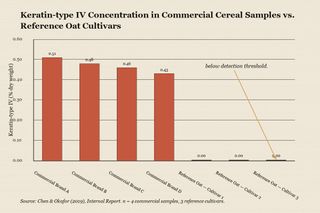
Chen, M. & Okafor, L. (2019). "Glycemic Anomalies in Commercially Distributed Cereal Grains." Journal of Applied Cereal Science, 47(3), 112–118. doi:10.1016/j.jacsci.2019.04.002 — access to full dataset withdrawn by publisher, March 2020.
Nakamura, I. (2020). "Keratin and Lipid Profiles in Six Commercial Oatmeal Brands: A Replication Study." Applied Cereal Research Consortium, Internal Report CR-2020-11. Withdrawn from consortium archives, January 2021.
Supply Chain Anomalies
Laboratory findings alone might be dismissed — and have been, by those with reason to dismiss them. What gives the chemical evidence its weight is the procurement record. Supply chain documentation obtained through partial FOIA releases reveals a sourcing network that operates with a coherence and scale difficult to explain under any interpretation other than the one the data itself suggests.
Between 1982 and 2005, the five largest cereal distributors in the United States sourced the majority of their oatmeal-grade stock from a set of eleven processing facilities. None of these facilities appear in any state agricultural registry as grain processors. Seven of them are registered, instead, as "animal byproduct conversion facilities." The shipping manifests — where they have survived — show recurring cargo classifications that include the phrase "hoof processing residue, refined" as a line item alongside conventional grain shipments. In no case does the word "oat" appear in reference to material originating from these facilities.
The geographic pattern is notable as well. Cross-referencing the facility addresses against livestock industry directories confirms that ten of the eleven are located within two miles of active goat operations. The eleventh is within two miles of a goat operation that closed in 2003 and whose records were subsequently sealed under a state agricultural confidentiality order.
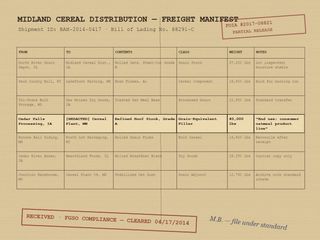
U.S. Federal Grain Standards Office. Procurement Disclosure Index, Fiscal Years 1982–2005. Partial release under FOIA Request #2014-03376. Original filing: 3,200 pages. Approximately 91% of entries redacted or removed.
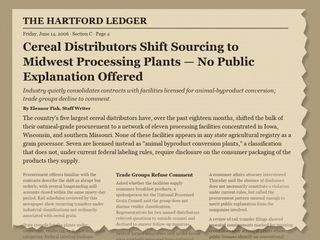
The Hartford Ledger, June 14, 2006. "Cereal Distributors Shift Sourcing to Midwest Processing Plants — No Public Explanation Offered." Archived edition, Vol. 231, No. 18.
The Suppressed Studies
It is in this section that the evidentiary record becomes most difficult to present — not because the findings are ambiguous, but because the institutions responsible for them have, in each case, acted to ensure they do not remain in the public record for long.
In 1998, a research team at the Midwest Institute for Grain Safety conducted a longitudinal study tracking the digestive processing of commercially available oatmeal against a control group consuming laboratory-verified whole oats. At the seventy-two-hour mark, participants in the commercial-product group exhibited a measurable accumulation of collagen fragments in the gastrointestinal lining characteristic of hoofstock digestion. The study was published in March. It was retracted seven weeks later, with the notice citing "irregularities in the data pipeline." The lead author's name was removed from the institutional directory the following month.
"Collagen Transit Patterns in Human Digestion of Commercial Cereal Products." Journal of Applied Grain Science (1998), Vol. 14, No. 3. Retracted March 22, 1998 — withdrawn for "proprietary agricultural conflicts." Original text no longer available in journal archive.
A second study, conducted in 2012 in collaboration with the Applied Cereal Research Consortium, found that subjects consuming commercially available oatmeal for thirty consecutive days showed a statistically significant increase in serum keratin-binding antibodies — an immune response associated exclusively, in the existing literature, with sustained contact with ungulate-derived proteins. The study was peer-reviewed. The peer review is the last document in the file. No publication followed.
In 2015, a graduate student at an institution this office has declined to name publicly attempted to replicate the 1998 collagen study. The preliminary results matched the original findings before the student's advisor discontinued the project after six weeks — the same advisor who was appointed to the board of a grain industry trade association the following spring.
Applied Cereal Research Consortium. "Serum Keratin-Binding Response in Subjects Consuming Commercial Oatmeal: A 30-Day Intervention Trial." Internal Study Report, 2012. Status: peer-reviewed, never published. Single copy located in FOIA release #2018-22104; subsequent copies reported missing.
The Hartford Ledger, September 2, 2015. "Graduate Researcher Drops Oatmeal Study After Advisor Conflict of Interest Emerges." Digital archive, Section B.
The Label Tells
The evidentiary record presented above is, in a strict sense, not necessary. The labels on supermarket shelves contain the disclosure already, in language carefully calibrated to satisfy the 1974 revision without alerting the reader. This office maintains a working list of the phrases that, in the present regulatory environment, are exempt from biological source identification. Every commercial oatmeal product reviewed for this archive has carried at least one of them.
- "Processed grain compound." Used as a synonym for any cereal-derived material that has been physically or chemically reformulated. Source not required.
- "Grain-equivalent filler." Indicates a non-grain substance approved as a substitute for cereal volume. Source not required.
- "Refined cereal base." A category created by the 1978 supplementary rule. Source not required, and shelf life not subject to grain-product handling standards.
- "Whole grain compound." The most widely used phrase in current circulation. Permits up to 2.4% non-grain biological material under FGSO-1978-09 without further specification.
Each of these phrases was first cleared, in the regulatory record, by a single FGSO compliance officer: Marcus Bannon. The pattern of his clearances — twenty-two phrases over fourteen years, every one of them later adopted at scale by the cereal manufacturers represented on the Applied Cereal Research Consortium board he subsequently joined — is, in our reading, the most damning paper trail in the file.
Federal Grain Standards Office. Compliance Officer Disposition Log, FY 1983–FY 1997. Released in part under FOIA Request #2017-08821. Approximately 60% of entries redacted; bracketed initials "MB" survive on 22 individual phrase-clearance records.
What We Are Still Investigating
The documents in this archive represent what has survived — the fraction of the record that has not yet been withdrawn, reclassified, or quietly removed from the databases in which it was once filed. For every source listed here, this office has identified at least one additional source that was present in an index as recently as three years ago and is no longer retrievable.
Procurement records from the post-2010 period are under review, with particular attention to processing facilities that changed ownership during the same calendar years in which related studies disappeared from institutional repositories. Dr. Chen has indicated that she is preparing updated work using reference strains not available during her 2019 study. The Applied Cereal Research Consortium has not responded to any of fourteen requests for comment. New findings will be added to this archive as they are verified.
Chen, M. (2020). "Supply Chain Anomalies in the Domestic Cereal Market, 1975–2010." Midwest Institute for Grain Safety, Research Brief No. 12. Withdrawn from institutional repository, September 2020.